 This wasn’t as interesting as I’d hoped it would be all the way through, but I’m not unhappy I read it.
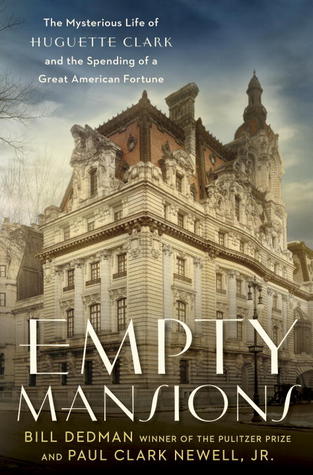
When he happened upon a mansion newly for sale that had been empty for over sixty years, journalist Bill Dedman was intrigued. The Santa Barbara estate, it turned out, was owned by the Clark family, one of the last remainders of W.A. Clark’s financial empire. Clark had been one of the top four or five richest men in the world in the early 1900s, and this mansion, belonging to his wife and then daughter, had been lovingly preserved in the same condition, empty, for decades. He set out on a mission to find out how something like that could come to be, and how the memory of one of the richest men in the world at one point, could have faded into history. What he ended up finding was Clark’s one remaining child, Huguette, reclusive and private beyond imagining, who had been hidden away in her New York apartment, and then for decades in small hospital rooms, while she spent away her fortune on what seemed like a whim. She lived until the age of 104.
The first half of this book wasn’t nearly as interesting to me as the second, and even then, they style of it never really grabbed me. I liked the reading the book, but I was never really in any hurry to pick it back up. The first third or so details W.A. Clark’s life, the building of his empire, and his eventual decline into old age and death. That’s when Huguette’s story takes over, and hers was far more interesting to me. Dedman works with an impressive amount of information, considering how private Huguette was, piecing things together. This is the closest we will ever get to knowing the mind of one of the wealthiest recluses in history, but I kept wanting more, which wasn’t the book’s fault. I wanted to know why, and the book wasn’t interested in trying to figure that out, just presenting facts. I wouldn’t go out of my way to recommend this, and some might find it fascinating, but the distance I felt from the subjects of the narrative kept me from fully enjoying it.
Despite that, though, there is some truly bizarre stuff in this book, and it might be worth reading just for that alone.