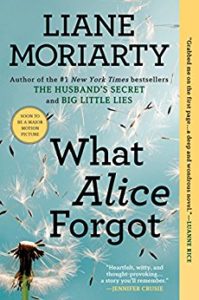
 It’s clear that the target reader for Liane Moriarty’s books is primarily female and, most likely, a parent and married woman. So I’m not sure why I gravitate to her books so much—I am female, but I am neither a parent nor married—but damn if I do love her stuff. When I start one of her books I am pulled in immediately and swept along the entire story. She does a fairly brilliant job of drawing up fun, interesting and complex characters, and keeping the general mystery that drives the plot humming along straight through until the very end (I have yet to “guess” the ending to one of her books, and I’m usually notorious for doing this). I also kind of enjoy that her books have a generally “happy” ending, because damn if the world isn’t a shitfest right now, and sometimes it’s nice to be in a world where everything is alright alright alright.
I’ve previously read Big Little Lies and The Husband’s Secret, and I would rank this below BLL and above THS, although I loved all three. In this story, we begin with Alice, who is waking up after hitting her head at the gym (amnesia trope alert—although I’ll forgive the cliché here). She suddenly believes it’s 1998, although in reality it’s 2008. As Alice tries to cope with her memory loss, she also has to come to terms with the Alice she’s apparently turned into in 2008—and it’s not often a person 1998 Alice can understand or even like. For one, she is apparently getting divorced from her husband, Nick, who 1998 Alice is still madly in love with. She is also apparently a queen bee PTA-leading super mom to three kids—although she doesn’t remember even giving birth to any of them, and 1998 Alice is far too shy and self-conscious to even lead a conversation at a party, let alone organize—as 2008 Alice is apparently doing—an event including dozens of moms to break the record for baking the world’s largest lemon meringue pie. She also now seems to be slightly estranged from her sister, Elizabeth, who is struggling with infertility, despite the fact that they had always been very close.
Most of the book is told from Alice’s perspective, but we also spend some time with Elizabeth, who shares her stories in diary entries she writes as “homework” assigned by her therapist; as well as Alice and Elizabeth’s “grandmother,” Franny, who writes letters to a secret man named Phil. In lesser hands, these side-perspectives (and their requisite side plots) would drag the pacing down or distract from the larger story, but I think it’s part of Moriarty’s gift to create fully fleshed-out side characters whose arcs you care about nearly as much as the main protagonists’.
What I found compelling about this book was considering, for myself, what 2007 Lindzgrl might think about 2017 Lindzgrl, and what a culture shock jumping ahead in time 10 years would be (it’s amusing listening to Alice reference frequent 1998 pop culture). It’s also interesting to consider what the younger, more idealistic, more naive version of yourself would think about the life being lived by someone older, wiser and more jaded. The debate, of course, is which is better, and I think this book does tend to romanticize the concept of innocence a bit too strongly, but it’s still a worthy read.