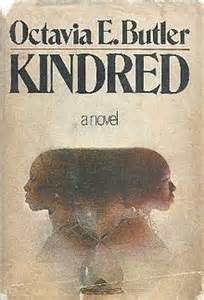
Kindred is a first-person narrative of a woman, Dana, and her husband, Kevin, being pulled back in time to save the life of her ancestor, Rufus, who seems perpetually prone to disaster. The catch is that she’s African American and Rufus is white, and lives in Antebellum Maryland.
I loved this book so hard.
The germ of this book occurred to Octavia Butler after she heard the anger of a young black consciousness activist targeting the subservience in older generations towards oppressive white culture. Paired with her own feelings of shame and anger over her mother’s job as a maid, and her grandmother’s status as a slave, Butler sought to explore what it meant to the people who actually worked in inherited, race-based servitude. After reading Between the World and Me, this confrontation with the complex and difficult historical legacy of African Americans was compelling. But Butler is no longer ashamed of her mother working as a maid to a family that didn’t respect her. She recognizes the heroism of a selfless daily struggle to provide for one’s family. Terrible cultural legacy be damned for want of food. That Butler sees heroism where others might see shame infuses the characters here with a humanity they might not otherwise have. These slaves don’t exist, narratively, so that we can shudder at the plight of slaves, they exist to remind us that slaves were individual human beings who mattered. The gross characterizations of Gone with the Wind and minstrel shows belie the reality of slavery not just because slaves are depicted as happy, but because subservient slaves have become an easy target for shame and anger. I think what Butler is saying, here, is that this is a strategy of survival not a natural result of cowardice, and that surviving can take just as much courage as martyrdom.
To Butler, this confrontation with the past is a necessary means of understanding the present, I think. The past and present are interwoven in this book: it begins at the end and is interspersed with flashbacks to the origins of Dana’s relationship with Kevin. We can’t move forward, here, without first looking at the past, but we can’t move backward without bringing the present with us. Dana is a modern black woman, and she’s having to deal with all that she expects from the world while living in a time and place that has removed all of her freedoms. Time is not just a plot device, it’s in the very DNA of what Butler is exploring.
I can’t recommend this book enough. It’s a multi-layered attempt to deal with the both the difficult past, the troubling present, and the complex pairing of the two, and it’s an empowering narrative that makes unmistakable the individual humanity in every form of struggle. But, setting all that aside, it’s a damn good book. Butler was a fine writer, and her characters feel real, complex, and likable.
Reviewed 11 times with an average rating of 3.91. Someone gave it 1 star all the way back in February 2013, though. So that’s different.